Dr. Al Gedicks
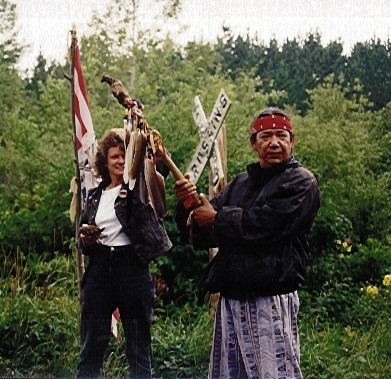
Sandy Lyon and Walt Bresette at the acid train blockade on the Bad River Ojibwe reservation. | Photo by Kathy Olson, published with permission.
Ojibwe environmental and treaty rights activist Walt Bresette will be inducted posthumously into the Wisconsin Conservation Hall of Fame (WCHF) in a virtual ceremony on April 17, 2024. Bresette will join over 100 members inducted since the Hall of Fame’s inception, including Aldo Leopold, Nina Leopold Bradley, John Muir, Gaylord Nelson and Menominee Nation environmentalist Hilary Waukau, Sr.
Bresette (1947-1999) was a member of the Red Cliff Band of Lake Superior Ojibwe, and a long-time treaty rights and environmental activist, author, artist, storyteller, organizer and public speaker. He was an outspoken advocate for Ojibwe treaty rights who asked people to come to the spring boat landings in northern Wisconsin during the spearfishing conflict (1980s-1990s). Walt wondered why people chose to go so far away to show support for others when there were urgent calls for solidarity closer to home. Bresette said, “You don’t have to go to Nicaragua to witness, you can witness in your own backyard.”
Walt was a founder of the Witness for Non-Violence for Treaty and Rural Rights in Northern Wisconsin, modeled on the group Witness for Peace, which was active during the Central American wars (especially in the Contra-backed areas of Nicaragua). The Wisconsin witnesses documented anti-Indian harassment and violence at the boat landings. By 1992, the efforts of the witnesses and a federal court injunction against anti-Indian harassment decreased the violence at the boat landings.
Bresette was a prolific organizer who brought together Native American and rural white communities through organizations like the Midwest Treaty Network, the Upper Great Lakes Green Network and the Wisconsin Greens. He said that the fight between Natives and non-Natives over the walleye harvest diverted attention from the far more significant pollution threat to the Wisconsin fishery for both groups from proposed metallic sulfide mining.
One of his most powerful messages was that Ojibwe treaty rights provided the greatest environmental protection against destructive metallic sulfide mining, like the Crandon and Ladysmith mining projects, in the ceded territory of the Lake Superior Ojibwe tribes. This was not because the tribes had a direct claim to minerals –—they definitely did not — but because mining threatens the environment, and a threat to the environment is a threat to Ojibwe fishing, hunting and gathering rights. Treaty rights provide the Ojibwe tribes with legal standing in federal courts to protect the habitat of fish, deer and wild rice.
Bresette was a leader in the successful resistance to the controversial Crandon mine next to the Sokaogon Ojibwe reservation (2003) and he led the grassroots campaign to enact Wisconsin’s “Prove It First” Mining Moratorium law. The law, signed by Governor Tommy Thompson on Earth Day, 1998, prohibited the opening of a new mine in a sulfide ore body until a mining applicant could prove they had not polluted surface water or groundwater in any of their previous mines in the U.S. or Canada.
As a non-violent Ogichidaag (protector of the people), Bresette was active in the opposition to the Rio Tinto/Kennecott copper mine next to the Flambeau River near Ladysmith, Wisconsin. In 1991, the Lac Courte Oreilles Ojibwe and the Sierra Club obtained a preliminary injunction against mine construction because the Wisconsin Department of Natural Resources (DNR) had failed to conduct an environmental assessment for endangered resources in the Flambeau River. Despite the restraining order, Kennecott continued construction activity at the site.
Bresette said that the State of Wisconsin had failed to protect the interests of the Lake Superior Ojibwe and decided to take action to protect the environment.
I witnessed Bresette climbingover a 10-foot security fence at the Flambeau mine site carrying a club once used by Black Hawk, and “counted coup” on a giant earth mover. The act of hitting the machine was a symbolic scoring of victory against one’s enemies but did no physical damage. In his trial for trespassing on mining company property, Bresette said the mining permit was illegal because the State of Wisconsin did not consult the Lake Superior Ojibwe about their treaty rights in the fishery of the Flambeau River before it issued the mining permit.
I interviewed Bresette for my documentary film, Anishinaabe Niijii (Friends of the First People), about the Indian and environmental resistance to the proposed Flambeau mine. Bresette and his good friend Sandy Lyon were co-founders of Anishinaabe Niijii. He said, “Someday our children are going to rise up and say, ‘Where were you when they poisoned my river?’” His words were prescient. The mine operated from 1993 to 1997. A Flambeau River tributary that crosses part of the reclaimed project site remains polluted to the present day.
Bresette and the Ogichidaa from the Bad River Ojibwe reservation were more successful in 1996 when they blockaded trains traveling through the reservation carrying sulfuric acid to a nearby copper mine in Michigan’s Upper Peninsula. The Ogichidaa were concerned that the tracks were unsafe and that a spill from tankers would poison reservation water and the largest wild rice stand in the Great Lakes region. The blockade lasted 28 days and prevented the transport of sulfuric acid across the reservation as a federal mediator conducted talks between the Ogichidaa, the tribe and the railway. The blockade and the assertion of tribal sovereignty protected the Bad River’s sacred wild rice beds and won the support of surrounding communities.
Walt was a charismatic storyteller who was a regular keynote speaker at the many Protect the Earth festivals, organized by Sandy Lyon, on Indian reservations throughout northern Wisconsin. His vision of a Seventh Generation Constitutional Amendment adopted the Iroquois concept that required Iroquois leaders to think about how today’s decision will affect the seventh generation into the future. The amendment promoted “the rights of the people to use and enjoy air, water, sunlight, and other renewable resources determined by the Congress to be common property, nor shall such use impair their availability for the future generations.”
Sandy Lyon summarized Bresette’s influence eloquently in a radio tribute broadcast on Woodland Community Radio WOJB-FM on the Lac Courte Oreilles reservation: “He was like the North Star and the people followed him.”
*published with permission.








 WOLF RIVER ACTION COMMITTEE