Category Archives: Allies

Walt Bresette, Ojibwe Leader and Environmental Hero, in Wisconsin Conservation Hall of Fame

Dr. Al Gedicks

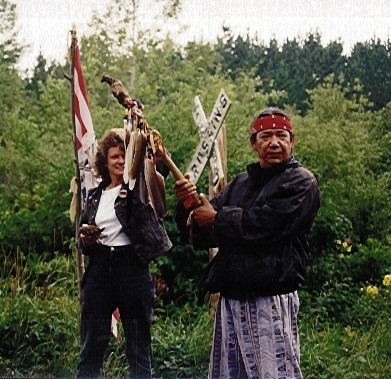
Sandy Lyon and Walt Bresette at the acid train blockade on the Bad River Ojibwe reservation. | Photo by Kathy Olson, published with permission.

Ojibwe environmental and treaty rights activist Walt Bresette will be inducted posthumously into the Wisconsin Conservation Hall of Fame (WCHF) in a virtual ceremony on April 17, 2024. Bresette will join over 100 members inducted since the Hall of Fame’s  inception, including Aldo Leopold, Nina Leopold Bradley, John Muir, Gaylord Nelson and Menominee Nation environmentalist Hilary Waukau, Sr.

Bresette (1947-1999) was a member of the Red Cliff Band of Lake Superior Ojibwe, and a long-time treaty rights and environmental activist, author, artist, storyteller, organizer and public speaker. He was an outspoken advocate for Ojibwe treaty rights who asked people to come to the spring boat landings in northern Wisconsin during the spearfishing conflict (1980s-1990s). Walt wondered why people chose to go so far away to show support for others when there were urgent calls for solidarity closer to home. Bresette said, “You don’t have to go to Nicaragua to witness, you can witness in your own backyard.”

Walt was a founder of the Witness for Non-Violence for Treaty and Rural Rights in Northern Wisconsin, modeled on the group Witness for Peace, which was active during the Central American wars (especially in the Contra-backed areas of Nicaragua). The Wisconsin witnesses documented anti-Indian harassment and violence at the boat landings. By 1992, the efforts of the witnesses and a federal court injunction against anti-Indian harassment decreased the violence at the boat landings.

Bresette was a prolific organizer who brought together Native American and rural white communities through organizations like the Midwest Treaty Network, the Upper Great Lakes Green Network and the Wisconsin Greens. He said that the fight between Natives and non-Natives over the walleye harvest diverted attention from the far more significant pollution threat to the Wisconsin fishery for both groups from proposed metallic sulfide mining. 

One of his most powerful messages was that Ojibwe treaty rights provided the greatest environmental protection against destructive metallic sulfide mining, like the Crandon and Ladysmith mining projects, in the ceded territory of the Lake Superior Ojibwe tribes. This was not because the tribes had a direct claim to minerals –—they definitely did not — but because mining threatens the environment, and a threat to the environment is a threat to Ojibwe fishing, hunting and gathering rights. Treaty rights provide the Ojibwe tribes with legal standing in federal courts to protect the habitat of fish, deer and wild rice. 

Bresette was a leader in the successful resistance to the controversial Crandon mine next to the Sokaogon Ojibwe reservation (2003) and he led the grassroots campaign to enact Wisconsin’s “Prove It First” Mining Moratorium law. The law, signed by Governor Tommy Thompson on Earth Day, 1998, prohibited the opening of a new mine in a sulfide ore body until a mining applicant could prove they had not polluted surface water or groundwater in any of their previous mines in the U.S. or Canada.

As a non-violent Ogichidaag (protector of the people), Bresette was active in the opposition to the Rio Tinto/Kennecott copper mine next to the Flambeau River near Ladysmith, Wisconsin. In 1991, the Lac Courte Oreilles Ojibwe and the Sierra Club obtained a preliminary injunction against mine construction because the Wisconsin Department of Natural Resources (DNR) had failed to conduct an environmental assessment for endangered resources in the Flambeau River. Despite the restraining order, Kennecott continued construction activity at the site. 

Bresette said that the State of Wisconsin had failed to protect the interests of the Lake Superior Ojibwe and decided to take action to protect the environment.   

I witnessed Bresette climbingover a 10-foot security fence at the Flambeau mine site carrying a club once used by Black Hawk, and “counted coup” on a giant earth mover. The act of hitting the machine was a symbolic scoring of victory against one’s enemies but did no physical damage. In his trial for trespassing on mining company property,  Bresette said the mining permit was illegal because the State of Wisconsin did not consult the Lake Superior Ojibwe about their treaty rights in the fishery of the Flambeau River before it issued the mining permit. 

I interviewed Bresette for my documentary film, Anishinaabe Niijii (Friends of the First People), about the Indian and environmental resistance to the proposed Flambeau mine. Bresette and his good friend Sandy Lyon were co-founders of Anishinaabe Niijii. He said, “Someday our children are going to rise up and say, ‘Where were you when they poisoned my river?’”  His words were prescient. The mine operated from 1993 to 1997. A Flambeau River tributary that crosses part of the reclaimed project site remains polluted to the present day.

Bresette and the Ogichidaa from the Bad River Ojibwe reservation were more successful in 1996 when they blockaded trains traveling through the reservation carrying sulfuric acid to a nearby copper mine in Michigan’s Upper Peninsula. The Ogichidaa were concerned that the tracks were unsafe and that a spill from tankers would poison reservation water and the largest wild rice stand in the Great Lakes region. The blockade lasted 28 days and prevented the transport of sulfuric acid across the reservation as a federal mediator conducted talks between the Ogichidaa, the tribe and the railway. The blockade and the assertion of tribal sovereignty protected the Bad River’s sacred wild rice beds and won the support of surrounding communities.

Walt was a charismatic storyteller who was a regular keynote speaker at the many Protect the Earth festivals, organized by Sandy Lyon, on Indian reservations throughout northern Wisconsin.  His vision of a Seventh Generation Constitutional Amendment adopted the Iroquois concept that required Iroquois leaders to think about how today’s decision will affect the seventh generation into the future. The amendment promoted “the rights of the people to use and enjoy air, water, sunlight, and other renewable resources determined by the Congress to be common property, nor shall such use impair their availability for the future generations.” 

Sandy Lyon summarized Bresette’s influence eloquently in a radio tribute broadcast on Woodland Community Radio WOJB-FM on the Lac Courte Oreilles reservation: “He was like the North Star and the people followed him.”

*published with permission.

Keepers of the Water (1996 Film)

Documentary directed by Professor Al Gedicks about the diverse coalition of environmental activists that fought together to successfully defeat the Exxon and Rio Algom proposed copper-zinc metallic sulfide mine and toxic waste dump on the banks of the Wolf River, in Crandon, northern Wisconsin.

This film was digitized into three parts through support from the University of Wisconsin-Madison Center for the Humanities

We Cannot Live Without Water: The Crandon Mine Movement 1976-2003

A short film made by Claudia Delgado for the National History Day project. The video provides some historical and cultural context behind the alliance against Exxon’s proposed Crandon mine at the headwaters of the Wolf River.

Artwork by Susan Simensky Bietila is included in this film: the Tommy Thompson jester puppet, the BAN CYANIDE banner and the installation of Tombstones dedicated to rivers poisoned by mining. Included are pages from the drawn stories, A Northwoods Tale and Water Protectors. You can see the entire stories at art-as-activism.blogspot and in World War 3 Illustrated magazine (AK Press). You can also see more of Susan’s work on our blog here.

Virtual Panel: Water Allies of the Wolf River

The second panel is live! Contribute your questions to the YouTube video.

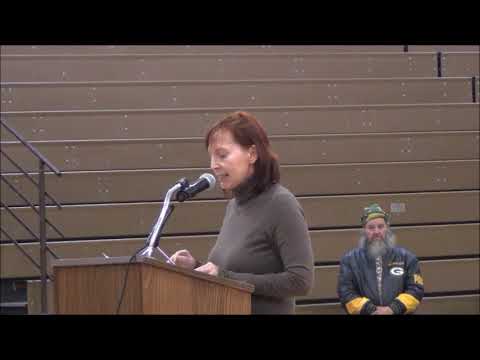
The second panel, Water Allies of the Wolf River, was moderated by Allison Werner. This panel happened the day after the Dakota Access Pipeline was closed down, which was appropriate timing to talk about water protection and activism. We had three panelists:

  • Anahkwet (Guy Reiter), a traditional Menominee and executive director of Menikanaehkem Community Rebuilders. 
  • Paula Mohan, a Political Scientist whose research focuses on intergovernmental relationships between tribes and state and federal governments.
  • Dale Burie, born in Menominee county and president of the Coalition to SAVE the Menominee River. 

Key takeaways:

  • The three panelists shared their unique experiences of protecting natural resources, specifically water, in Wisconsin and the Upper Peninsula of Michigan. A key theme of the panel was that anyone can act for protecting the environment—“you are somebody,” you can do something to help movements you care about move forward.
  • Guy has been an earth and water protector pretty much since birth. He grew up walking lightly on the earth and trying to understand his relationship with the natural world. The Menominee creation story starts at the mouth of Menominee River, so when the Back Forty Mine was proposed, Guy started to get involved in water protection. He learned about what sulfur mining was, its impacts on the natural world, put on events, and got people talking about the issue. He helped organize a 126-mile water walk over three days from the Menominee reservation to a Menominee sacred site, Keshena Falls, to the mine site. They walked with intent on the Earth, in a way to think about all of the animals, people, things that would be affected by the potential mine. 
  • Dale spoke of how his Christian beliefs drive his mission to preserve and take care of rivers of Wisconsin. He talked about the formation of his organization, the Coalition to SAVE the Menominee River, which just incorporated this past June. Dale said “it isn’t about us anymore, it’s about the next generations.”
  • Paula got involved in environmental activism in high school when Menominee students were peacefully protesting violent spearfishing opposition by resort owners in Conover, WI. She learned then what it means to be both a water ally and an ally to Indigenous people. She said that “the fact that tribes now have a say in what happens in ceded territory means that that watershed has protection that it would not have had otherwise.” She gave a few recommendations to non-natives that want to get involved in water protection: build strong relationships and allow tribes to lead the way and tell you what they need; learn about the regulatory process and where the weaknesses are; and remember that mining companies cannot compete with the resistance that comes with a hive mind and on multiple fronts. 
  • To get involved—become a volunteer, get vocal through letters, calls, and e-mails, develop a tough skin, and learn how to make this hard work fun. Build relationships with your elected officials from town board all the way to the federal level—they need to know these are issues you care about. 

Panelists

Anahkwet (Guy Reiter) is a traditional Menominee who resides on the Menominee Reservation. He is the executive Director of the Menominee Indian community organization Menikahnaehkem. He is a community organizer, activist, author, amateur archaeologist, lecturer, and member of the Menominee Constitutional Taskforce. Anahkwet has organized many events to uplift communities and demonstrated the richness of Menominee culture. He has lectured at Universities on the connection Menominee Indians have to the Menominee River. He has also written articles for Environmental Health News and others. Anahkwet is an advocate for indigenous people everywhere. When Anahkwet isn’t working you’ll find him enjoying time with his wife and children.

Paula Mohan is a Political Scientist whose research focuses on intergovernmental relationships between tribes and state and federal governments and best to enhance tribal sovereignty within those relationships. She currently teaches in the American Indian Studies program at UW-Madison. Paula is a life-long resident of Wisconsin and grew up in central Wisconsin and later, northern Wisconsin in a community bordering the Lac du Flambeau Ojibwa reservation. She has been an active ally with tribes since high school.  

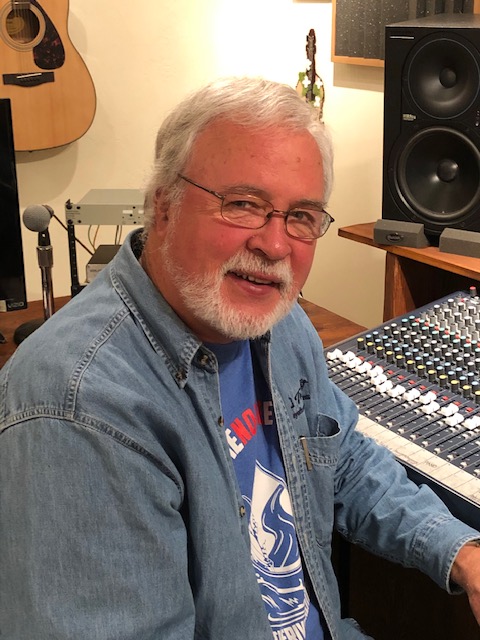
Dale Burie was born in Menominee and is now the president of the River Coalition. He is also a worship leader, musician, and vocalist.

Our Great Menominee River, Amen

This song was written by Elaine Mayer and performed by Dale & Lea Jane Burie

From the hidden springs of water
In our Upper Michigan,
Wisconsin waters rush to join in
To that sparkling band of water
That's been there forever,
She's our great Menominee River, amen! 

[Chorus] We have vowed to defend her
As her enemies go after
All the treasures that lie deep within.
We will fight to protect her
From those who don't respect her,
Our great Menominee River, amen!

She has carried life within her,
Run the paper mills beside her,
She's moved big timber down from the hills.
All the tribes and the trappers
Have their history within her,
Our great Menominee River, amen.

[Chorus]

Those foreign hands will kill her
If we don't band together,
She doesn't stand a chance on her own. 
There is strength in numbers,
United we can save her,
Our great Menominee River, amen!

She's our great Menominee River, amen!

Just watch her water flowing,
In the morning sun she's glowing,
Our great Menominee River, Amen!

Lyrics and Melody written by Elaine Mayer. All instrumentation and vocals by Dale Burie and Lea Jane Berinati Burie. Produced by Dale Burie and Lea Jane Berinati Burie. Recorded at ‘Tater Patch Recording Studio, Wausaukee, Wisconsin. Copyright and Published by: Dale Burie Music Group, BMI, Nashville, Tennessee.