Author Archives: ribmountain

Elevated Arsenic Detected in Wells at Reclaimed Flambeau Mine Site

For Immediate Release, March 1, 2024 

Contacts:  Laura Gauger, Deer Tail Scientific (Duluth, MN); Tel: (218) 724-3004

                    Dr. David M. Chambers, Center for Science in Public Participation (Bozeman, MT); Tel: (406) 585-9854

Elevated Arsenic Detected in Wells at Reclaimed Flambeau Mine Site

– Wells within 140 feet of Flambeau River are Contaminated; State officials have taken no action

Groundwater quality testing at the reclaimed Flambeau Mine site south of Ladysmith has revealed high concentrations of arsenic in two wells located within 140 feet of the Flambeau River. Wisconsin’s drinking water standard for arsenic is 10 parts per billion (ppb). Water samples collected from the wells in May 2023 and tested by Flambeau Mining Company (FMC) and the Wisconsin Department of Natural Resources (DNR) show arsenic concentrations ranging from 15 to 24 ppb.

Before the Flambeau Mine was constructed in the early 1990s, arsenic concentrations of less than 5 ppb were reported in wells across the project site (i.e., the toxin was undetectable). That changed in 1999, shortly after the mine’s waste water treatment plant (WWTP) was shut down and the unlined mine pit was backfilled with the sulfide-containing waste rock and WWTP sludge that had been generated during operations and stored on liners alongside the mine pit.

Arsenic concentrations ranging from 42 to 83 ppb were measured in the deepest wells within the backfilled Flambeau Mine pit in July 1999 and remain elevated to the present day (41 to 53 ppb in May 2023). Arsenic concentrations in the two wells mentioned at the outset, both located in a 140-foot-wide sliver of bedrock between the backfilled pit and Flambeau River, spiked in 1999 as well and have exceeded Wisconsin’s 10 ppb drinking water standard on numerous occasions over the past two decades.

Other contaminants have also exceeded standards in a number of wells at the project site. Manganese, which is known to cause Parkinson’s-like nerve damage at elevated concentrations, has gone as high as 42,000 ppb in a well within the backfilled Flambeau Mine pit, compared to the public health standard of 300 ppb.

According to information provided by FMC to the Wisconsin DNR, the contaminated water from the backfilled Flambeau Mine pit is on the move and entering the Flambeau River. As stated in the company’s 1989 Mine Permit Application:

“ …  all of the groundwater flowing through the [high sulfur] waste rock in the reclaimed pit will exit the pit through the Precambrian rock in the river pillar and flow directly into the bed of the Flambeau River. Since this flow path is very short and occurs entirely within fractured crystalline rock, … the concentrations of [dissolved] constituents in the groundwater leaving the pit will be the same as the concentrations entering the river bed.”

Longtime conservationist Laura Gauger claims that FMC and its parent company, Kennecott/Rio Tinto, misled the public regarding the likelihood of contaminated waters entering the Flambeau River from the backfilled mine pit and has backed up the claim with a photo of a plaque that FMC displayed at the mine site during operations in the mid-1990s.

Plaque displayed by FMC at the Flambeau Mine project site in the mid-1990s.

Gauger, who co-authored a book about the Flambeau Mine with Roscoe Churchill of Ladysmith in 2007, recounted the following story:

“During the 1989-90 permitting process for the Flambeau Mine, local citizens voiced concerns that groundwater polluted with heavy metals from the Flambeau Mine would get into the nearby Flambeau River. In response, FMC distributed a brochure claiming the bedrock between the mine pit and river would provide a barrier ‘stronger than the Hoover Dam.’ The company reiterated the claim on a plaque displayed at the project site in the mid-1990s.”

She continued: “Years later, a public records request unearthed a technical report that FMC had submitted to the Wisconsin DNR in 1989 as part of the permitting process – a report that concluded the rock between the pit and river was ‘fractured’ and that contaminated groundwater leaving the mine pit would ‘flow directly into the bed of the Flambeau River.’ The public had been duped.”

In light of the high concentrations of arsenic now being recorded in wells at the Flambeau Mine project site, concern has once again been raised by citizens for the health of the Flambeau River. The DNR-approved monitoring plan for the river, however, does not require FMC to report any biological or surface water sampling data for the section of the Flambeau River immediately adjacent to the backfilled mine pit where the contaminated groundwater is entering.

The closest surface water sampling site in the Flambeau River is about 500 feet downstream of the backfilled pit, and the closet biological sampling station, last sampled by FMC in 2011, is about 2,000 feet downstream. The test panel utilized by the company for surface water analysis is also limited. The only metals being tested are copper, iron, manganese and zinc. The DNR has not required FMC to test the river water for arsenic, sulfate or a variety of other substances known to be present in Flambeau waste rock such as uranium, aluminum, cobalt and nickel.

Nor has the DNR required FMC to drill any monitoring wells on the west side of the Flambeau River (opposite side from pit) to determine if the plume of groundwater contamination emanating from the backfilled pit and headed in that direction has extended beyond the river to properties on the other side.

A 1988 memo issued by Foth, FMC’s primary environmental consultant, included the following statement that apparently was designed to rationalize the decision to drill no wells west of the river and quell public concern: “The river is in the way. It is clearly impossible, then, for any activities at the mine, on one side of the river, to affect any water wells on the other side of the river.”

Foth’s sweeping statement has been challenged by experts like Dr. Robert E. Moran (Michael-Moran Associates, Golden, CO), a seasoned hydrogeologist who reviewed FMC’s monitoring program several years ago. He pointed out that the Flambeau River “is only about 5 feet deep in the vicinity of the 225-foot deep mine pit” and stated that “the overall hydrogeological relationships … indicate significant volumes of pit groundwater may be flowing downgradient below the Flambeau River, in the deeper alluvial sediments and or bedrock.”

Dr. Moran went on to advocate for wells being drilled and tested on the west side of the river “to determine whether groundwaters west of the Flambeau River have been negatively impacted by FMC operations.” The same recommendation was made by Dr. David M. Chambers and Dr. Kendra Zamzow (Center for Science in Public Participation, Bozeman, MT) in a 2009 report that identified various surface and groundwater contamination issues at the reclaimed Flambeau Mine project site. 

FMC continues to claim in annual submissions to the Wisconsin DNR that “the Flambeau River remains fully protected and Flambeau remains in full compliance with its permit standards.” But Gauger, who is concerned with FMC’s failure to test for arsenic or any other contaminants in the stretch of the river alongside the mine pit or to drill any monitoring wells west of the river, has referred to FMC’s test program as “Don’t Ask. Don’t Tell.”

In light of the high concentrations of arsenic in groundwaters exiting the backfilled Flambeau Mine pit and entering the Flambeau River, citizens are hopeful that something can be done to protect the river and properties across the river from the pit. Thus far, however, the Wisconsin DNR has taken no action.   

####
Walt Bresette, Ojibwe Leader and Environmental Hero, in Wisconsin Conservation Hall of Fame

Dr. Al Gedicks

Sandy Lyon and Walt Bresette at the acid train blockade on the Bad River Ojibwe reservation. | Photo by Kathy Olson, published with permission.

Ojibwe environmental and treaty rights activist Walt Bresette will be inducted posthumously into the Wisconsin Conservation Hall of Fame (WCHF) in a virtual ceremony on April 17, 2024. Bresette will join over 100 members inducted since the Hall of Fame’s  inception, including Aldo Leopold, Nina Leopold Bradley, John Muir, Gaylord Nelson and Menominee Nation environmentalist Hilary Waukau, Sr.

Bresette (1947-1999) was a member of the Red Cliff Band of Lake Superior Ojibwe, and a long-time treaty rights and environmental activist, author, artist, storyteller, organizer and public speaker. He was an outspoken advocate for Ojibwe treaty rights who asked people to come to the spring boat landings in northern Wisconsin during the spearfishing conflict (1980s-1990s). Walt wondered why people chose to go so far away to show support for others when there were urgent calls for solidarity closer to home. Bresette said, “You don’t have to go to Nicaragua to witness, you can witness in your own backyard.”

Walt was a founder of the Witness for Non-Violence for Treaty and Rural Rights in Northern Wisconsin, modeled on the group Witness for Peace, which was active during the Central American wars (especially in the Contra-backed areas of Nicaragua). The Wisconsin witnesses documented anti-Indian harassment and violence at the boat landings. By 1992, the efforts of the witnesses and a federal court injunction against anti-Indian harassment decreased the violence at the boat landings.

Bresette was a prolific organizer who brought together Native American and rural white communities through organizations like the Midwest Treaty Network, the Upper Great Lakes Green Network and the Wisconsin Greens. He said that the fight between Natives and non-Natives over the walleye harvest diverted attention from the far more significant pollution threat to the Wisconsin fishery for both groups from proposed metallic sulfide mining. 

One of his most powerful messages was that Ojibwe treaty rights provided the greatest environmental protection against destructive metallic sulfide mining, like the Crandon and Ladysmith mining projects, in the ceded territory of the Lake Superior Ojibwe tribes. This was not because the tribes had a direct claim to minerals –—they definitely did not — but because mining threatens the environment, and a threat to the environment is a threat to Ojibwe fishing, hunting and gathering rights. Treaty rights provide the Ojibwe tribes with legal standing in federal courts to protect the habitat of fish, deer and wild rice. 

Bresette was a leader in the successful resistance to the controversial Crandon mine next to the Sokaogon Ojibwe reservation (2003) and he led the grassroots campaign to enact Wisconsin’s “Prove It First” Mining Moratorium law. The law, signed by Governor Tommy Thompson on Earth Day, 1998, prohibited the opening of a new mine in a sulfide ore body until a mining applicant could prove they had not polluted surface water or groundwater in any of their previous mines in the U.S. or Canada.

As a non-violent Ogichidaag (protector of the people), Bresette was active in the opposition to the Rio Tinto/Kennecott copper mine next to the Flambeau River near Ladysmith, Wisconsin. In 1991, the Lac Courte Oreilles Ojibwe and the Sierra Club obtained a preliminary injunction against mine construction because the Wisconsin Department of Natural Resources (DNR) had failed to conduct an environmental assessment for endangered resources in the Flambeau River. Despite the restraining order, Kennecott continued construction activity at the site. 

Bresette said that the State of Wisconsin had failed to protect the interests of the Lake Superior Ojibwe and decided to take action to protect the environment.   

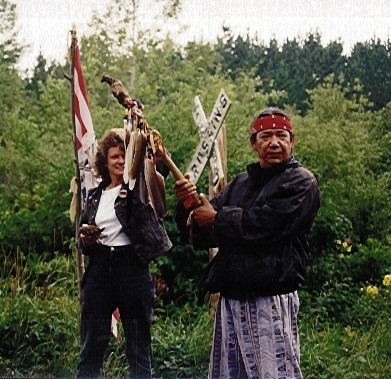
I witnessed Bresette climbingover a 10-foot security fence at the Flambeau mine site carrying a club once used by Black Hawk, and “counted coup” on a giant earth mover. The act of hitting the machine was a symbolic scoring of victory against one’s enemies but did no physical damage. In his trial for trespassing on mining company property,  Bresette said the mining permit was illegal because the State of Wisconsin did not consult the Lake Superior Ojibwe about their treaty rights in the fishery of the Flambeau River before it issued the mining permit. 

I interviewed Bresette for my documentary film, Anishinaabe Niijii (Friends of the First People), about the Indian and environmental resistance to the proposed Flambeau mine. Bresette and his good friend Sandy Lyon were co-founders of Anishinaabe Niijii. He said, “Someday our children are going to rise up and say, ‘Where were you when they poisoned my river?’”  His words were prescient. The mine operated from 1993 to 1997. A Flambeau River tributary that crosses part of the reclaimed project site remains polluted to the present day.

Bresette and the Ogichidaa from the Bad River Ojibwe reservation were more successful in 1996 when they blockaded trains traveling through the reservation carrying sulfuric acid to a nearby copper mine in Michigan’s Upper Peninsula. The Ogichidaa were concerned that the tracks were unsafe and that a spill from tankers would poison reservation water and the largest wild rice stand in the Great Lakes region. The blockade lasted 28 days and prevented the transport of sulfuric acid across the reservation as a federal mediator conducted talks between the Ogichidaa, the tribe and the railway. The blockade and the assertion of tribal sovereignty protected the Bad River’s sacred wild rice beds and won the support of surrounding communities.

Walt was a charismatic storyteller who was a regular keynote speaker at the many Protect the Earth festivals, organized by Sandy Lyon, on Indian reservations throughout northern Wisconsin.  His vision of a Seventh Generation Constitutional Amendment adopted the Iroquois concept that required Iroquois leaders to think about how today’s decision will affect the seventh generation into the future. The amendment promoted “the rights of the people to use and enjoy air, water, sunlight, and other renewable resources determined by the Congress to be common property, nor shall such use impair their availability for the future generations.” 

Sandy Lyon summarized Bresette’s influence eloquently in a radio tribute broadcast on Woodland Community Radio WOJB-FM on the Lac Courte Oreilles reservation: “He was like the North Star and the people followed him.”

*published with permission.

December ALL MEMBER

WUUSAN’s ALL MEMBER meeting for December will feature Anahkwet (Guy Reiter), excutive director of the Menominee community organization Menīkānaehkem Community Rebuilders  and Director of Rights of Nature Wisconsin. 

Date: December 13, 2023

Time: 6:00 – 7:30 PM

Location: On line.  

All Member meetings are available to anyone on the mailing list and invited guests.  Please register to receive the Zoom link.

https://click.everyaction.com/k/74264090/441085565/-273693840?nvep=ew0KICAiVGVuYW50VXJpIjogIm5ncHZhbjovL3Zhbi9UU00vVFNNVVUvMS8xMDU0MjIiLA0KICAiRGlzdHJpYnV0aW9uVW5pcXVlSWQiOiAiMWY3NzY3YzUtMDY4Zi1lZTExLTg5MjUtMDAyMjQ4MjIzY2JhIiwNCiAgIkVtYWlsQWRkcmVzcyI6ICJuc3RlbmNpbDc5ODNAZ21haWwuY29tIg0KfQ%3D%3D&hmac=IcdFoTLGDXEe--o4ynVGjxkr6gvqUt2cY_JQDnyXa7w=&emci=23681382-e68e-ee11-8925-002248223cba&emdi=1f7767c5-068f-ee11-8925-002248223cba&ceid=5603

PROTECT THE PORKIES, STOP THE CHOPPERWOOD MINE!

Protect The Porkies will hold their first Virtual Townhall, to be held on Saturday, December 9th, at 12pm CST. You can find the Zoom information below. There will be a 15-20 minute presentation giving an overview of the current state of affairs of the Copperwood Mine and our resistance campaign, followed by a question/comment/discussion period. 

The meeting will be open to the public, so feel free to pass along word to anyone who might be interested. 

Here is the petition, please sign:

https://click.e.change.org/f/a/U77twvV8xln0_TloZI9wFg~~/AANj1QA~/RgRnTx90P4QqAWh0dHBzOi8vd3d3LmNoYW5nZS5vcmcvcC9wcm90ZWN0LXRoZS1wb3JraWVzLWNhbmNlbC10aGUtY29wcGVyd29vZC1taW5lL3BzZi9zaGFyZT9jc190az1Bdmh0Y0J2SHhKSDlSZlRVZFdVQUFYaWN5eXZOeVFFQUJGOEJ2RGJCSEwxNzVZUC1Ja2M4NUdNd09SWSUzRCZ1cGRhdGVfaWQ9MzIxNDYxOTMmdXRtX2NhbXBhaWduPTY5M2YxN2E4MWIxYTQyZjJhYTM2OTg4YzU1MjdkY2Q4JnV0bV9jb250ZW50PXZhcmlhbnRfdjBfN18wJnV0bV9tZWRpdW09ZW1haWwmdXRtX3NvdXJjZT1wZXRpdGlvbl91cGRhdGUmdXRtX3Rlcm09Y3NXA3NwY0IKZWt0mmxlmph8EFIWbnN0ZW5jaWw3OTgzQGdtYWlsLmNvbVgEAAAAAg~~

Topic: COPPERWOOD VIRTUAL TOWN HALL DISCUSSION
Time: Dec 9, 2023 12:00 PM Central Time (US and Canada)

Join Zoom Meeting
https://us02web.zoom.us/j/82918547765?pwd=UjIyUjFHSVUwdmZTSVZzTmNucktkZz09

Meeting ID: 829 1854 7765
Passcode: 081074

One tap mobile
+13052241968,,82918547765#,,,,*081074# US
+13092053325,,82918547765#,,,,*081074# US

Dial by your location
• +1 305 224 1968 US
• +1 309 205 3325 US
• +1 312 626 6799 US (Chicago)
• +1 646 931 3860 US
• +1 929 205 6099 US (New York)
• +1 301 715 8592 US (Washington DC)
• +1 346 248 7799 US (Houston)
• +1 360 209 5623 US
• +1 386 347 5053 US
• +1 507 473 4847 US
• +1 564 217 2000 US
• +1 669 444 9171 US
• +1 669 900 6833 US (San Jose)
• +1 689 278 1000 US
• +1 719 359 4580 US
• +1 253 205 0468 US
• +1 253 215 8782 US (Tacoma)

Meeting ID: 829 1854 7765
Passcode: 081074

Find your local number: https://us02web.zoom.us/u/kd1B7RiXy2

CRANDON MINE PURCHASE ANNIVERSARY CELEBRATION HELD

By Tina L. Van Zile, Environmental Director

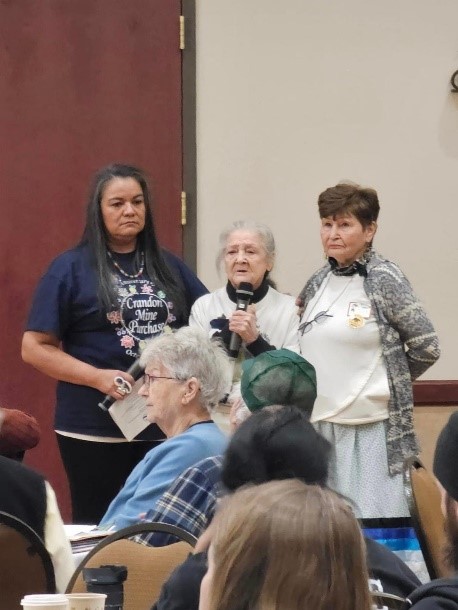
Last Saturday was the 20th Anniversary Celebration for the historic Crandon Mine Purchase. Events were held at the Mole Lake Casino and Lodge Conference Center and the Forest County Potawatomi Community Center. We started the day off with an opening drum song from the Sokaogon Singers, and their second song brought in the Sokaogon Chippewa Veterans Color Guard.

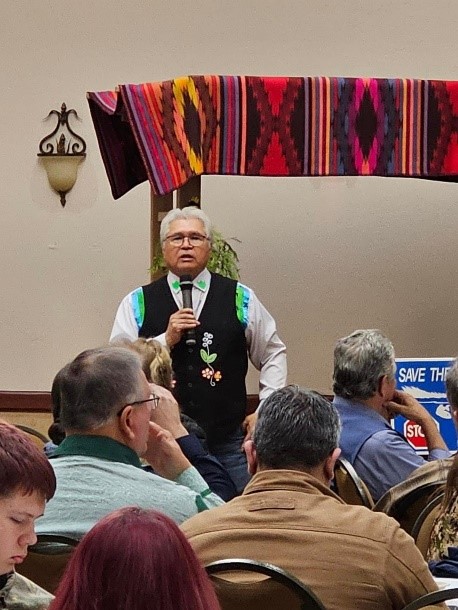
Chairman Robert Van Zile, Jr. and Chairman James A. Crawford each welcomed everyone to the glorious day. Then Chairman Van Zile offered a prayer for the day’s events and began his oral presentation, that included history of the 28-year battle against the mining companies. He shared significant information that many people probably didn’t remember, like the trip to Johannesburg, South Africa. Chairman Van Zile, Glenn Reynolds, Ken Van Zile and Roman Ferdinand met with BHP Billiton and explained the disaster that the Crandon Mine would create for the Sokaogon people if they continued to pursue the project.

Frances Van Zile was very emotional during her talk because this was the first time she didn’t have Fred Ackley, Jr. by her side. She said, “This is so hard without my Freddy,” and we all became teary eyed with her because we felt her pain.

Fran and Fred were a force to be reckoned with during the 28-year battle. They attended many marches, meetings, gatherings, etc., all to represent the Sokaogon People. Fran said, “Dale Alberts, (Crandon Mine President at the time) told me, Franny do you really think tying tobacco ties to the trees out here is going to stop this mine,” and Fran replied, “Yes, yes it will,” and now look at us here today celebrating the 20th anniversary since we prevented the mine!”

Everyone clapped and hooped because we all knew our tobacco offerings are powerful. I told Franny, “I want you to know that you gave many of us inspiration to join the fight along with you. You have taught us all very well, and I assure you that we will carry on the fight against mining, and we will educate our youth about the 28-year battle so it will never be forgotten!”

During the mining opposition we had four Tribes standing side by side with us. We called ourselves “Niiwin (four in Ojibwe) Tribes”. Ken Fish represented the Menominee Nation during the celebration. Ken was very instrumental during the opposition, as he headed the treaty rights division for his Tribe back then. I remember Ken and Apsenahkwat traveling together, along with the Sokaogon Chippewa and Forest County Potawatomi, to Washington D.C. to spearhead federal agencies and their review of the proposed Crandon Mine EIS process, demanding answers on Tribal cultural concerns. Menominee Nation was a strong ally!

Sokaogon thought it was important to fly Zoltan Grossman and Debi McNutt from Olympia, Washington, to Mole Lake for the celebration because they led the charge for Midwest Treaty Network. Zoltan and Debi were community organizers who educated non-Natives throughout Wisconsin during the proposed mine era.

Their grass-root organization worked with many other Wisconsin grass-root organizations, combining their forces and joining the Tribes in the fight against the proposed Crandon Mine. They were instrumental in leading “speaking tours” in towns all along the Wolf River. The education they provided to people who would be affected downstream from the Sokaogon Chippewa Reservation was pivotal in gaining support. The proposed mine was not just a threat to the Sokaogon people, but everyone downstream because Swamp Creek, which runs through the reservation, is at the headwaters of the Wolf River.

Throughout the morning, we heard from GLIFWC’s John Coleman and Former Sokaogon Tribal Hydrogeologist Roman Ferdinand. Both John and Roman reviewed hundreds of technical data submitted by the mining company as they pursued their mining permits from the Wisconsin Department of Natural Resources. It was a great weight on their shoulders, but they never gave up. They attended numerous technical meetings over the years and they both proved to play a vital role because they, in turn, had to explain this technical information to Tribal leaders.

Roman worked for the Sokaogon Chippewa for 20 years, and we are extremely thankful for his dedication to our people! GLIFWC formed a mining team which included Ann McCammon-Soltis and Esteban Chiroboga, and they all deserve much credit for assisting the Tribes. Today, they continue to represent Ojibwe Tribes who are facing threats from mining.
Glenn Reynolds, former Tribal Attorney, talked about the many legal challenges the Tribe faced. Back in 1995, the U.S. Environmental Protection Agency (EPA) granted the Sokaogon Treatment-As-A-State (TAS) for our Water Quality Standards, but the State of Wisconsin immediately sued the EPA stating the Tribes didn’t have jurisdiction over their waters.

Glenn was not only providing legal representation on all the mining-related threats but now he had to defend the Tribe’s right to TAS as well. Glenn spoke about how Nicolet Minerals (the last name of the proposed Crandon Mine project) contacted the Tribe to see if we would be interested in purchasing Spirit Hill. Of course we said yes, go back and tell them we’ll buy it and ask them if they want to sell the land around Oak Lake too. Glenn and Roman both went and talked to the President of Nicolet Minerals, and they came back and said, “This guy is interested in selling more than just Oak Lake land.”

One thing led to another, and we were negotiating for all the land. Glenn believes the trip to South Africa and meeting with Brian Gilbertson, President of BHP Billiton, to inform him of what devastation would be done if the proposed Crandon Mine project went into operation just two miles upstream from our reservation, had an impact. Two weeks after that meeting, BHP Billiton shut down the Crandon Mining office.

It was then that the Connor Family purchased the mining company from BHP Billiton, but they could not fund the expensive permitting process. This opened the door for the Tribe to purchase it all.

Sayokla Kindness-Williams and Justice Peche from the Indigenous Environmental Network (IEN) and Western Mining Action Network (WMAN) shared a couple stories of IEN’s involvement back in the early 1990s when they held a Protect The Earth Summit here at Mole Lake to bring worldwide attention to the threat Sokaogon was facing.

Sayokla spoke about WMAN bringing me to Kamloops, British Columbia, to speak about putting an end to the proposed Crandon Mine. She said, “Tina spoke so eloquently and passionately that she made hundreds of people cry. At the end of her presentation, she received a standing ovation from over 300 people.” She added, “Tina is an excellent speaker when it comes to telling the story of the 28-year battle against the Crandon Mine.”
Sayokla and Justice gifted me with a ribbon skirt, maple syrup, Native sewn towels, shell earrings and more, and it brought me to tears because she asked everyone to give me a round of applause and I received a standing ovation. This touched my heart so much that I could not hold back the tears.

Al Gedicks was the next speaker. He spoke with so much passion and a hint of anger because he has a direct connection to Sokaogon. His best friends are Danny (Sokaogon Tribal Member) and Sherry Poler. It was Danny who asked for his help back in the early 1970s when Exxon was the first mining company to go after mining permits.

Al does his research, and he can challenge any company when it comes to something he is passionate about. One thing in particular that Al stated was that if the mining company were to open this Crandon Project, they would be committing cultural genocide. Al talked about a “social license to operate” – which means the mining company works to win over the support of the community where their mining activity will take place. Without this social license, it creates political and financial problems for mining companies. That’s why it is important for communities to actively show opposition if they do not want mining in their back yards.

Dave Blouin of the Sierra Club Wisconsin Chapter, spoke of their involvement throughout the years. Dave has been an avid activist fighting mining companies, and he is very good at investigating the financial background of mining companies. He has told me many times, “You can tell what’s going on by diving into a company’s financials, because they are all about what kind of profit they can make.”

Dave currently meets by Zoom every month with many of us activists, and we discuss current proposed mining projects so we can collectively work to prevent these projects in Wisconsin and in our ceded territories.

Allison Werner of the River Alliance of Wisconsin wasn’t involved during the 28-year fight, but her organization assisted Sokaogon by keeping an eye on things down in Madison. The River Alliance always works to do their best to educate people about the truth of mining projects and then they let people make their own decision. The River Alliance always has a board member from a Tribe to ensure their involvement with the Tribes, as well as including the Native perspective on all the good work they do across Wisconsin.

My daughter, Tashena Van Zile, was asked by a Milwaukee Journal Sentinel reporter to be taken to the former Crandon Mine property because I was way too busy to leave the event. She took him to the location of the ore body and told him how it would have devastated our rice beds because of the close proximity to the reservation. She then took him to the north end of Rice Lake so he could see where “the food that grows on water” is. It made me happy to see that Tashena could share her personal knowledge because she was a young girl who traveled with me everywhere addressing many state and federal agencies during the permitting process.

Jeff Crawford is the General Counsel for the Forest County Potawatomi and he gave history of the proposed Crandon mine. He said that for him personally, he would always get inspiration from a prayer from the late Jim Thunder, and that to ensure their Tribe doesn’t entertain mining, they have changed their constitution to make those decision in the hands of the General Council membership. Jeff also shared that they would need a super majority and it would be difficult to get that in any decisions within their Tribe. He hopes this will protect future generations.

I was last to speak after the long day of presenters. I showed a presentation mostly of maps and pictures that reflected on the history of the former proposed Crandon mine project. I wanted people to see the map that shows just how close the project would have been to the Sokaogon Chippewa Community.

It’s one thing to tell people that we are only two miles downstream, but for them to see on a map how close it really is, they began to realize that the mining project would have devastated our homelands.

I made sure to thank the NiiWin Tribes as well as the many Wisconsin grassroots organizations who stood side-by-side with the Sokaogon to defeat the proposed Crandon Mine. Similar to Jeff Crawford, I, too, shared how I maintained the strength to carry on each day. I would visit our Historical Marker, which tells people about the Battle of Mole Lake, and no matter what I was facing I needed to be strong like our ancestors who died fighting for our wild rice beds.

This gave me strength every day, and I honestly thought I would be fighting the proposed Crandon mine project until the day I died. We, as Native peoples, rarely WIN against mining companies, so when we struck the deal to make the purchase it was extremely emotional. It was as if someone cleared the black clouds over our reservation and our people could finally rest easy!

The happiest moment at the celebration was seeing all the Native and non-native warriors seeing one another again. People were hugging and reminiscing of the struggle we all endured. I personally shed tears a few times. But looking across the crowd of people, I also saw many smiles! It was a good day to have a good day.
I have so many people to thank for helping make the day a joyous one. First, the Sokaogon Chippewa Tribal Council and the Forest County Potawatomi Executive Council for providing the modest budget for the event. Secondly, I would like to thank the planning team members including Jacki Braun, Tashena Van Zile, Tiffany McGeshick, Narciso Tovar, Amber Haseman, Dillon Crawford, Marcus Daniels, Jessica Jacobsen and Matt DeLeew. Thank you to the Potawatomi Traveling Times designer who took our hand drawing floral work and digitized it to complete our T-shirt design. He then transferred it for our beautiful poster. Thank you to Nathan Podany, Mike LaRonge and Joel Polar for hauling everything before, during and after the event. Thank you to my personal friends who came to volunteer including Chantel Alveshire, TJ and Sayokla Kindness-Williams.

I had some fabulous cooks for the lunch and feast, including Norbert Polar, Mark Van Zile, Jr., Chris McGeshick, Vickie Ackley, Cheyenne Landru, Mike Krusensterna, Virginia Poler, Jacki Braun, Maxine Trudeau and James Polar, Sr.

Thank you to the Lac du Flambeau National Resources Department for donating all of our eco-friendly paper products. Thank you to my granddaughter’s father, Hunter Mayo, for harvesting and donating two deer for the feast. Thank you to the Potawatomi Farm for donating grass-fed beef for the feast.

When you have a good team, it makes an event like this go smoothly. Everyone worked so hard, and I truly appreciate every one of them!

Lastly, thank you to Jeremy Wild from our Sokaogon C-Store and Renae from the Mole Lake Lodge for working with me to buy out their stock of gifts for our powwow giveaway.

If I have forgotten anyone, I apologize now.

Chi-Miigwech to all who played a role in making the day a success!
Photos courtesy of Kimberlee Soldier.

Reprinted with permission.

Respecting -Honoring -Acknowledging –Remembering

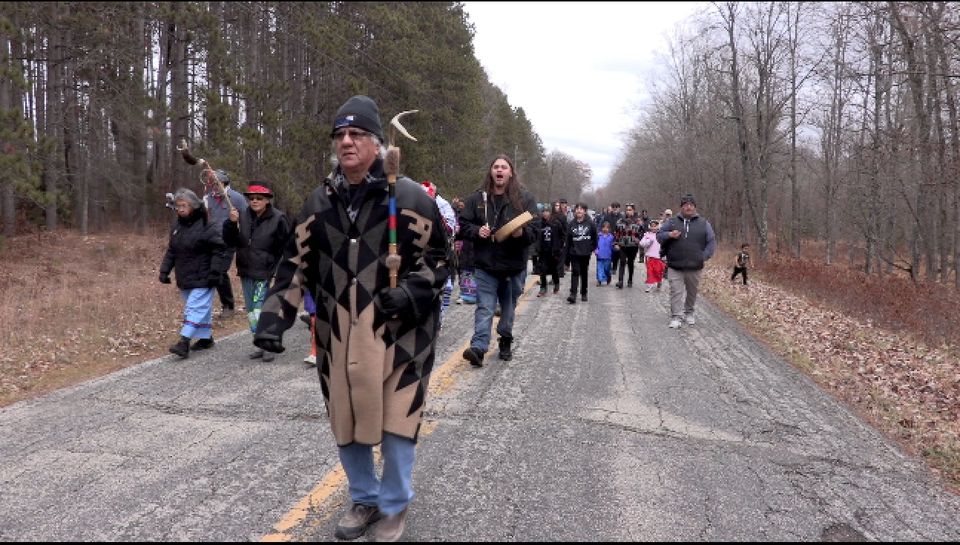
 Certain persons of Menominee Indian Heritage, the Coalition to Save the Menominee River, private area landowners and others, joined in a Peaceful Awareness Walk amongst the Ancestors of the Menominee people. The location was Sixty Islands on the Menominee River west of Stephenson, Michigan.

The day began at sunrise with a water ceremony. The sunrise teachings help to deepen connections with the earth and strengthen the work of all. The ceremony was followed by opening words from area leaders as well as short talks regarding the area’s history and significance. A light breakfast was served.

The National Park Service has listed on The National Register of Historic Places the Sixty Islands area of the Menominee River near Stephenson, Michigan. This site, “Anaem Omot,” which translates to “The Dog’s Belly” is the traditional name for the Sixty Islands area. This area in Michigan and Wisconsin features archeological remains of Indigenous burial mounds, dance circles and ancient agriculture. Tribal members have paid homage to this location for many years making offerings and wishes for good luck to the young woman who spirit visits the terrace overlooking 60 Islands “Anaem Omot is a traditional cultural place significant to the Menominee Indian Tribe,” wrote National Park Service spokesperson Ellie Stuckrath.

The walk began at 11 AM. Women and girls are to wear long skirts, while men and boys were to wear ribbon shirts or vests or wear the best. Comfortable shoes for walking through the woods are necessary.

The walk itself began on the open gate side of Boneyard Road. The reasoning behind the walk was to drawn attention to the proposed mine would indeed pollute the water and damage the historical sites as well as all properties along the Menominee river. Participants traversed through the woods on the logging road known as Boneyard Road. Boneyard Road is a public Road that Gold Resources Company has gated off. The area is rich with culture. We walked past the area of the Indigenous burial mounds. We were immersed in ancient culture. Many of us tied our prayer bundles to trees in the woods. We exited from the woods by walking under and around the gated, no trespassing area. We were met by company security guards who called law enforcement. There were no arrests or citations.

Approximately 75 people attended the feast that followed the walk. Closing remarks followed the feast.

THE PHOTO OF ONE HUNDRED SHARES

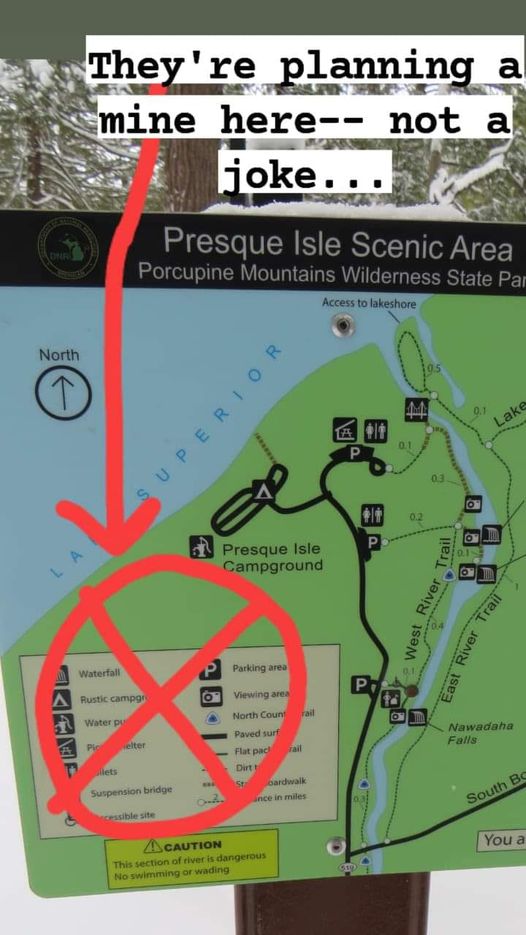
 Sometimes all it takes is someone sharing a photo that draws attention. “They’re planning a mine here—not a joke.” This photo above is worth a thousand words and received one hundred shares on Facebook in very short amount of time. This photo woke sleeping giants that walk among us for the good. This mining project is slated for this coming year.

Anyone who has spent time in the Upper Peninsula of Michigan has seen the bountiful beauty, the waterfalls, Lake Superior, and the endless forests. The Porcupine Mountains State Park, especially the Presque Isle scenic area, all resting on the shores of Lake Superior, is absolutely priceless. Why would anyone want to destroy this?

Highland Copper aims to mine under State Park land, under the Presque Isle River, and possibly even under Lake Superior. This would be in the west end of the Porkies. Plans are for the water to be drawn from Lake Superior for industrial uses. Lake Superior holds one-fourth of the world’s fresh water. There will be altering of wetlands and streams as well. Adding to all this, there is also interest in redeveloping the White Pine Mine, on the east side of the Porkies, and using this for milling the ore and storing hazardous mine waste; forever. White Pine was initially closed around 1995, and there have been many environmental contamination concerns such as tailing basins and brownfields. This is ecocide and no one is taking ownership of this burden, except maybe you and I, the taxpayer. This project will literally “bookend” the Porkies. Picture that, a mine on each end of the Porkies.

We know there has never been a sulfide mine that does not pollute. Why are our law makers allowing our waters to be polluted with heavy metals? This is a Canadian based copper company coming in to intentionally, and deliberately destroy our land. Copper is not a critical mineral, and it can be much more easily recycled but this seems to fall on deaf ears due to greed; greedy people that tell us there is no money in recycling.

 Again, we need to speak up, and speak up now and loudly. Our rivers and streams sustain life and should have the same inherent rights and protection that people and corporations do. Make your voice heard, it is my responsibility and yours to speak out for the earth. Our water is a source, not a resource. Speak out before every drop of clean water is gone. Water is life.

Since this writing was published, a website has been created, videos have been made, interviews have been given. Please visit: www.ProtectThePorkies.com